A teaching case from the Kingston Health Sciences Centre COVID-19 Assessment Centre. On the design conditions healthcare imposes that corporate workspaces do not.
In March of 2020, the conversation about acoustic privacy changed for everyone working in healthcare, and the conversation about pods changed with it. The Kingston Health Sciences Centre needed COVID-19 assessment space at a velocity its existing built environment could not match. The hospital had built-out exam rooms. It needed more, it needed them now, and it needed them designed for a kind of clinical encounter the original architecture had not anticipated.
I worked on this project from inside the manufacturer side. The pod that was eventually deployed, the SnapCab Care pod, was developed in close collaboration with Dr. Joy Hataley, a family practice anesthetist and the District Chair of the Ontario Medical Association, along with other Kingston physicians including Dr. Omar Islam and Dr. Johanna Ortiz. My own contribution was the visual design of the pod’s exterior. I want to speak to that piece directly later in this case, because the graphics decision is one of the more useful examples I know of how patient experience is shaped by surfaces most clinical projects treat as neutral.
The opening situation
The Assessment Centre needed to test people fast, safely, and with a level of dignity that the rapid-response cubicles thrown up in other facilities did not deliver. The traditional built-out exam room was not the answer. Renovations took time the hospital did not have. Tents and partitions were faster but compromised privacy and air control. The hospital needed something between a built room and a temporary partition. Something modular, movable, clinically rated, and quiet.
This is the moment in the project where the brief looks like a procurement problem and actually is not. It is a design conditions problem. The hospital was being asked to deliver a kind of space the existing building did not have a category for.
The quiet problem
In a corporate setting, acoustic privacy is mostly about productivity. In a clinical setting, it is about something different. It is a precondition for the encounter itself.
A patient walking into an assessment for a contagious illness brings real anxiety with them. The first job of the space is to receive that anxiety without amplifying it. The acoustic envelope matters because what the patient says about symptoms, exposure, and household members is genuinely private. The visual envelope matters because the patient is being seen in a moment they would not choose to be seen in. The air envelope matters because the staff and the next patient and the patient before are all in the same building, and what the room exchanges with the corridor is a clinical question.
In the book I am writing, Rooms Within Rooms, the chapter on healthcare names this directly. Privacy in healthcare is not a productivity enhancement. It is a clinical obligation. The brief looks fundamentally different when that shift happens, and the decisions that follow look different too.
The decisions
Three decision points are worth pulling out of this project.
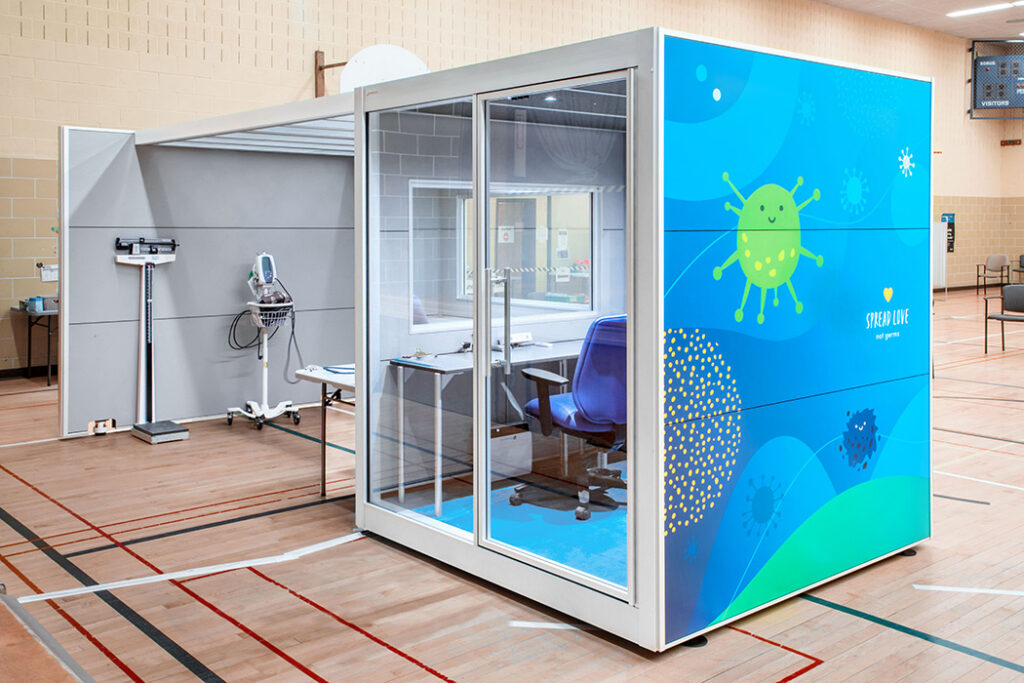
The first was treating air and acoustic as a single envelope. Most acoustic pods in commercial use rely on recirculated air through filtration. For a clinical pod in a pandemic, that calculus had to change. The Care pod was specified with HEPA-filtered air, designed so the exchange between the inside of the pod and the corridor was controlled, not assumed. The acoustic seal and the air seal became the same design problem. That is rarely true in corporate work. It is almost always true in clinical work.
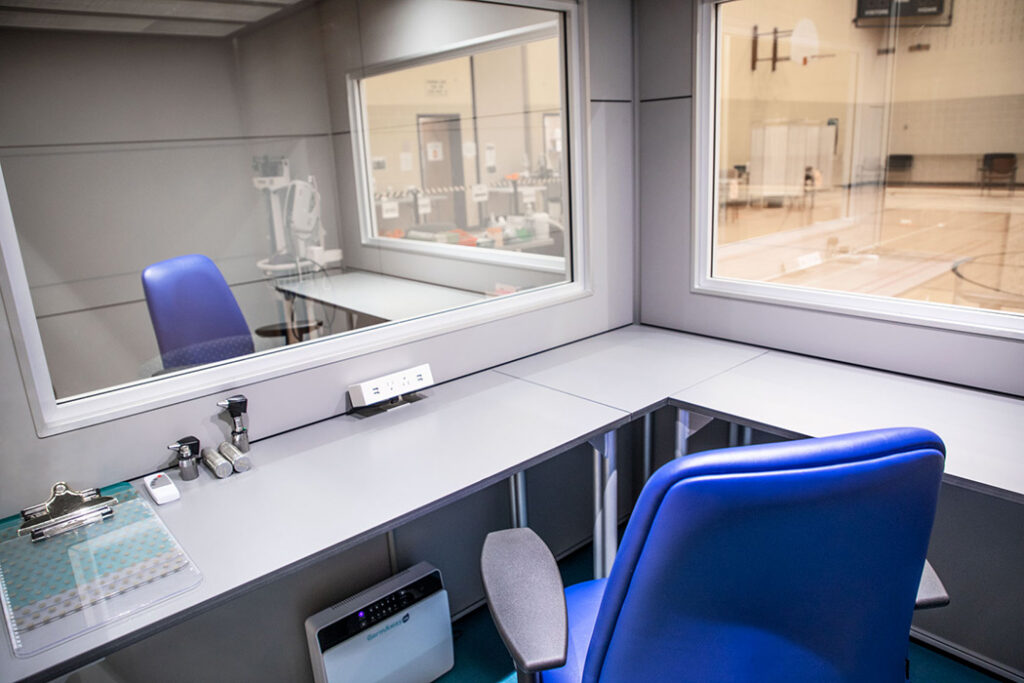
The second was one-way glass. A pediatric or anxious adult patient inside the pod could be observed by clinical staff without feeling observed in the same way. The patient sees their own reflection. The clinician sees the patient. That asymmetry is unusual in commercial design and very much at home in clinical design, and it is the kind of detail that makes the difference between a space that feels like an exam room and a space that feels like a waiting closet. The decision to specify one-way glass was a clinical decision, and it was also an experience decision. The two are inseparable in this context.
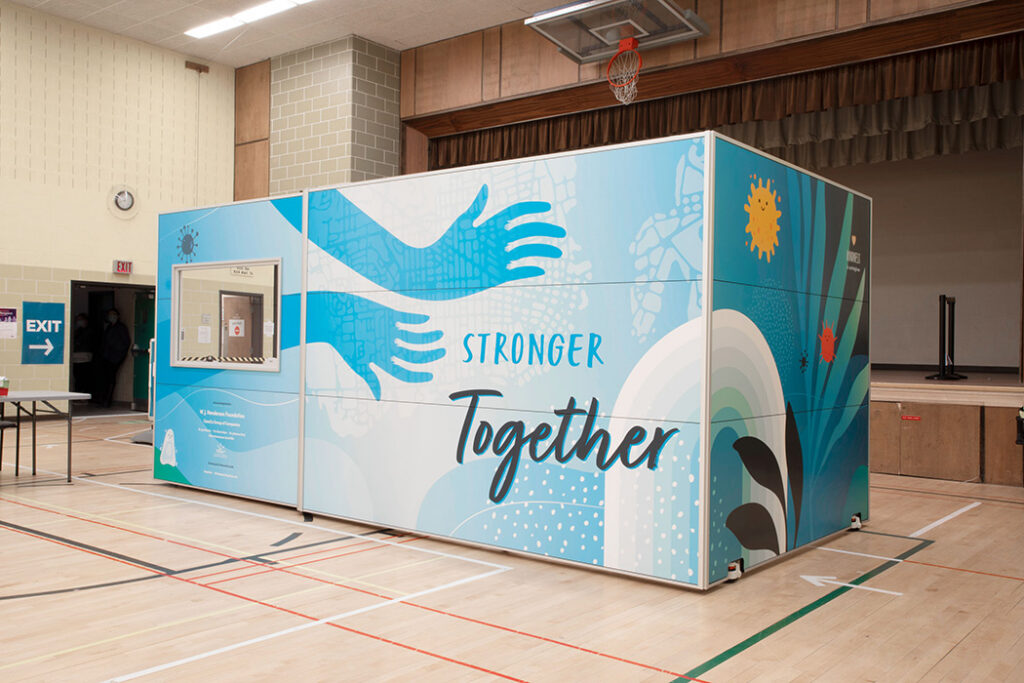
The third was the graphics. This is the part of the project I owned directly, and I want to walk through it carefully because it is the kind of decision most pod projects skip and most healthcare environments leave to whoever ordered the wallpaper.
The exterior of the Care pod was originally going to be a clean clinical envelope. White, sealed, professional. Correct on every clinical metric and entirely uninviting to the children and anxious adults who were going to be invited into it. The graphics I designed for the exterior took a different approach. An aerial view of Kingston rendered as a stylized illustration. Hands holding hands as a motif around the perimeter. The visual surface of the pod became a statement about community, about the city the patient belonged to, about the people on the other side of the wall who were also trying to get through this. It was not decoration. It was a piece of the clinical experience.
The thing to take from that detail is that the visual surface of a healthcare pod is a clinical surface. Treating it as decoration is a missed opportunity. Treating it as part of the patient experience is a design move with real outcomes.
What it looks like in use
The Care pod was deployed at the Assessment Centre and ran through the height of the pandemic response. Dr. Ortiz, who visited the centre after deployment, said the workflow felt organized, the patient experience felt safe, and the space felt less stressful than the alternatives available at the time. The pod was later recognized with a Fast Company World Changing Ideas Award, a DNA Paris Design Award in Responsible Design, and an Interior Design HiP Award in Health and Wellness.
The recognition is the visible part of the project. The less visible and arguably more important part is what the pod taught us about modular healthcare architecture. The asset that solved an acute crisis remains an active part of the clinical environment, because the design was never tied to one diagnosis or one moment. It was tied to a class of conditions where rapid, private, contained clinical space matters.
The portable lesson
When privacy becomes a clinical obligation, the brief becomes a different brief. Acoustic envelope, air envelope, visual envelope, and experience envelope all collapse into one design problem. The teams that do this work well treat them as one problem. The teams that struggle treat them as four problems handled by four trades.
If there is one thing worth carrying into your next healthcare project, it is the framing. A healthcare pod is not a piece of furniture in a clinical room. It is a clinical room. Specify it accordingly, on every dimension, including the surfaces nobody else will treat as part of the brief.